Quick Answer
Although nonsurgical options for turkey neck can treat loose skin and crepey jowls to some extent, these methods cannot provide dramatic improvement or eliminate the visible signs of aging entirely. One of the current treatments, radiofrequency microneedling for turkey neck utilizes heat energy that penetrates the deeper layers of the skin to promote collagen production and skin tightening for a rejuvenated appearance. A pilot study using a fractional radiofrequency device with insulated needles demonstrated significant improvement in lower facial laxity and neck sagging after the treatment.
However, the supporting research is limited by the methodology and quality of the trials. The condition being treated and the degree of its severity determine the appropriate treatment measures. Thus, if the turkey neck is characterized by very loose skin, submental fat, or prominent muscle bands, separately considering each option is necessary. If the patient has excessive hanging skin, a surgical procedure may be recommended.
What Causes Turkey Neck?
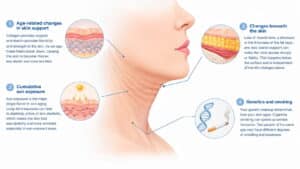
The appearance commonly called turkey neck can reflect various age-related changes in different layers of the neck.
Age-related changes in skin support
Collagen provides support and elastin provides flexibility and strength to the skin. Age-related changes in the connective tissue of the skin decrease its strength and elasticity, and causes the outer surface of the skin to become thinner. You may see skin that springs back less, appears thinner, and feels looser and more wrinkled.
Cumulative sun exposure
Sun exposure is the major single factor in skin aging. Long-term exposure is associated with elastosis, a loss of skin elasticity that is most noticeable on sun-exposed areas. You may see skin that looks less stretchy and more wrinkled in sun-exposed areas.
Changes beneath the skin
These changes occur below the surface of the skin, independently of the skin changes above. In the face and neck, changes include the loss of muscle tone, and a decrease in the thickness of the fat layer underneath the skin, resulting in less support and fullness. This combined with thinning of the skin, can give the neck a drooping or flabby appearance. Muscle tone is only one contributor to this change in the neck.
Genetics and smoking
Your genetic makeup determines how your skin ages. It is an unavoidable risk factor. Cigarette smoking is an avoidable exposure that probably contributes to faster formation of wrinkles. You might observe that two people of the same approximate age have different degrees of wrinkling and looseness.
A variety of these changes can take place simultaneously, explaining why the appearance of the neck varies from person to person.
How To Get Rid Of Turkey Neck Without Any Surgery ?
Morpheus8 is a brand name of a particular device, which is used for performing radiofrequency (RF) microneedling. The method is based on employing two aspects in the treatment, namely the thin needles used to pierce the skin and the RF energy that supplies the heat. As opposed to the traditional microneedling techniques, where needles are utilised to pierce the skin to trigger repair mechanisms, the RF energy added to the procedure generates an additional enhancement. Specifically, the RF energy transfers heat to the deeper layers of one’s skin.
How can it improve loose or crepey neck skin?
Crepey, loose skin has thinner skin with less collagen and elastin. The theory behind controlled heating is to stimulate the repair process, during which the body gradually produces new collagen and remodels existing collagen fibers. This is a biological process, and the outcome of such a process cannot be guaranteed – and will be different on every person.
A pilot study of fractional RF with insulated microneedles in the lower face and neck showed objective improvement in mild-to-moderate laxity, although reviews on RF for skin laxity note that study quality is generally low. Published data are mostly limited to single-center, industry-sponsored, or combined-treatment studies, so results should be interpreted with caution.
Laxity improvements could manifest as firmer skin and reduced appearance of crepey skin, but they are unlikely to remove excess skin. Radiofrequency microneedling for turkey neck will not necessarily address prominent vertical bands, or remove hanging bands of skin. Likewise, it will not necessarily remove fat beneath the chin, which is not always an issue for everyone considering this treatment. It is a tool in the non-surgical treatment of turkey neck, not an answer to every cause.
Whether Morpheus8 is right for you depends on the concern you want to address and if the treatment fits with your expectations.
Who May Be Suitable for Morpheus8, and Who May Not?
Eligibility depends on whether the neck concern is primarily one of skin quality and laxity (rather than substantial amounts of loose skin), the extent and severity of the concern, personal medical history, and an in-person evaluation, rather than age alone.
Who May Be a Candidate?
- Mild-to-moderate skin laxity or crepey quality, with the primary concern being skin quality (not large amounts of loose or hanging skin)
- A neck condition primarily characterized by skin concerns (rather than bands of muscle or fat)
- Having realistic expectations about the outcomes and limitations of treatment
- Ability to comply with post-treatment care and skin recovery
- Skin and health status that appears suitable for the procedure after screening
Who May Need to Postpone or Avoid Treatment
- Large amounts of loose skin: This treatment is generally not suitable for significant excess or very loose neck skin.
- Prominent platysma muscle bands: Visible vertical neck bands may require a different procedure that directly addresses the muscle.
- Predominantly fatty fullness: If the primary concern is not skin quality or laxity but rather excess fat, another treatment may be more appropriate.
- Implanted electronic devices: Patients with pacemakers, defibrillators, or similar devices were excluded from the manufacturer’s study protocol.
- Active skin conditions or cold sores: Active skin disease in the treatment area, or cold sores at the time of treatment, may necessitate treatment delay or additional medical management.
Our Morpheus8 Treatment at Hudson Aesthetics
At Hudson Aesthetics, the Morpheus8 treatment is implemented by Dr. Kerline Marcelin who is board certified in ophthalmology by the American Board of Ophthalmology and board certified in aesthetic medicine by the American Academy of Procedural Medicine.
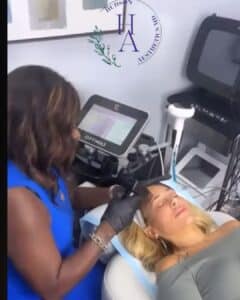
Morpheus8 is an effective solution for tightening up your ‘turkey neck.’ Radiofrequency microneedling can penetrate the deep layers of your skin to boost collagen and elastin production and, in turn, improve the texture and tone of your skin. The result is visibly tighter, smoother skin – but not completely ‘erased,’ just improved.
What defines our approach?
Our Morpheus8 treatment is based on several documented aspects, each of which has a practical implication for you:
- Zones of application: Face – neck – cheeks – jawline. The lower part of the face, including the jowls, is also involved in the procedure. Therefore, if the problem occurs due to sagging skin in the lower part of the face along the jawline, this area is also subject to treatment.
- Two-in-one method: The rollers make punctures in the skin, and radio waves conducted through these rollers affect deeper layers of the skin. The Morpheus 8 handpiece has pins that heat up fat and connective tissue.
- Anesthesia: A topical anesthetic may be applied to the skin prior to the procedure.
- Series of procedures: A series of three treatments is usually required rather than a single session.
The skin-tightening procedure is indicated to correct skin laxity but does not claim to address all the causes of a double chin, and thus is not an alternative to surgical intervention.
What generally happens during the procedure?
There are differences in the approach to each clinic, but most seem to follow a similar sequence that looks something like this:
- Assessment: The clinician inspects your neck and determines whether you have loose skin, bands, or fat that need to be addressed.
- Preparation: The skin is cleansed, and the options for numbing are discussed. Your level of discomfort will vary.
- Treatment: Hand-held device is used in a systematic manner with specific settings determined by your skin type and neck condition.
- Aftercare: You’ll be sent home with specific instructions. If you experience redness or swelling after treatment, they’re only minor and should subside. You may want to call the clinic if you experience increased pain, blistering, or signs of infection like redness and swelling.
What Our Morpheus8 Microneedling Patients Say About Us ?
Watch Our Morpheus8 patients reviews.
Your treatment journey at Hudson
Start with a consultation. You can set up a Morpheus8 consultation in our office.
Attend your treatment sessions. Treatments are performed in a our Cortlandt Manor clinic. A numbing cream may be applied, and your provider will make one to three passes over the treated area with the device. Each session takes about 30 to 60 minutes. Three sessions spaced about four to six weeks apart are usually needed.
Give yourself time to heal and see results. Over the next 1 to 3 days, you may have redness, itching, or swelling and plan to take it easy for a few days. You may see some immediate results, but your skin may keep improving for 3 to 6 months as collagen grows and rebuilds.
How Morpheus8 Works on the Chin and Jawline
Radiofrequency microneedling involves very fine needles that penetrate the skin and deliver a form of heat called radiofrequency (RF) to the underlying tissue. The needles themselves create a pathway in the skin, but it’s the additional delivery of RF that differentiates this treatment from regular microneedling. Morpheus8 combines the two in a single procedure.
The skin then uses this controlled injury as a stimulus to heal and repair itself. The addition of RF heat has been found to increase the body’s production of collagen and, as mentioned on our treatment page, can also stimulate the production of elastin. Collagen provides the scaffolding that gives skin its structure and support, and elastin allows the skin to stretch and recoil, so an increase in both can result in skin that looks and feels tighter. This reaction is a gradual process and can differ from person to person.
At Hudson, we use Morpheus8 on the face and neck, including the jowls and jawline, to improve the appearance of loose skin. That’s what radiofrequency microneedling for turkey neck is primarily intended to address: skin quality and mild-to-moderate skin laxity. Although treatment may affect some underlying fat, it should not be relied on to remove substantial fat beneath the chin or treat a double chin.
How Long Does Morpheus8 Take to Show Results?
The initial results of the treatment are usually visible after several days, while the final outcome is observed at three to six months after treatment, since collagen synthesis is a slow process and multiple sessions are needed for improvement. One or two treatments are considered to be an initial result, which is not the final outcome of the treatment.
Three sessions spaced four to six weeks apart are recommended before assessing the maintenance. It is notable that three treatment sessions are normally sufficient to produce satisfactory results. Additionally, maintenance sessions are suggested.
What Are the Risks of Morpheus8?
Redness, itching, and swelling are some of the most common side effects after a Morpheus8 treatment. They usually last for about 1-3 days, so it is advisable to plan your social life and important events accordingly. According to the FDA, other frequent side effects include redness, itching, dryness, discomfort, bruising, and bleeding.
The list of contraindications and side effects Morpheus8 is not limited to the ones mentioned above. The FDA warns that some of the complications that may occur after a Morpheus8 treatment may be severe. Among the most dangerous side effects are burns, scars, fat loss, disfigurement, and nerve damage.
After Morpheus8, the patient should keep the treated areas clean and avoid using any topical products and cosmetics until the skin is fully recovered. It is also essential to use a high protection (minimum SPF 30) sunscreen on the treated areas before going outside. The FDA strongly recommends consulting a medical professional about the appropriate post-treatment care since the skin may be particularly sensitive to UV radiation and other skincare products.
Before considering the procedure, it is advisable to consult a professional to discuss the possible risks and benefits and ask any questions regarding your case.
Is Morpheus8 the Right Treatment for Your Neck Concerns?
Whether Morpheus8 is right for you depends on the concern you want to address and if the treatment fits with your expectations.
Your primary concern. Morpheus8 is used to treat ‘loose or sagging’ skin with ‘non-surgical skin tightening, including the neck, jowls and jawline, but everyone has different concerns. Tightening or firming isn’t the only way sagging skin around the neck is addressed.
Your expectations for the results. With Morpheus8, the appearance of loose skin, wrinkles and uneven skin texture may improve, but the treatment does not promise to entirely remove them. Although radiofrequency microneedling may affect some underlying fat, it should not be relied on to remove substantial under-chin fat or treat a double chin. It is not a surgical alternative for significant excess skin.
Your practical considerations. Clients have 3 treatments of approximately 30 – 60 minutes, with the treatments scheduled ‘approximately every 4–6 weeks’ and a few days of social downtime. The results are noted to last anywhere between 3 – 6 months, with the option to have maintenance treatments, but no timeline is given for how often maintenance treatments are needed or how long the results of any treatment last.
Frequently Asked Questions
1.What are the best non-surgical treatments for turkey neck available in the US?
Ans: No single treatment suits every neck, so the right choice depends on what you are seeing:
- Loose skin: ultrasound (Ultherapy), radiofrequency (Thermage), radiofrequency microneedling such as Morpheus8, or non-ablative lasers.
- Crepey texture: resurfacing lasers such as CO2 or Fraxel, and prescription retinoids.
- Vertical neck bands: Botox or similar neuromodulators, which relax the platysma muscle. Effects last about three to six months.
- Fat under the chin: Kybella injections or CoolSculpting.
These treatments work best for mild to moderate concerns. Advanced laxity or significant excess skin is generally better addressed surgically. Some plastic surgeons also rate non-invasive options as less effective and temporary, so ask for realistic expectations before you start.
2. What causes crepey skin on the neck?
Ans: Neck skin is thinner than facial skin and has fewer oil glands. Collagen and elastin, the proteins that give skin firmness and recoil, break down with age, and sun exposure speeds this up. Genetics and extreme weight loss also affect how your neck ages. The result is fine, crinkled, thin-looking skin that can appear before other signs of ageing.
3. Which clinics offer effective non-invasive procedures for crepey skin on the neck?
Ans: At Hudson Aesthetics in Cortlandt Manor, NY, Morpheus8 is offered for the face and neck, including the jowls and jawline. Most people need three sessions, spaced four to six weeks apart. None of the sources ranks clinics, so choose on qualifications and fit, not on claims of effectiveness.
4. How much do non-invasive neck tightening procedures cost?
Ans: Cost depends on how many sessions you need. Radiofrequency treatments are typically a series of about three, Ultherapy is generally a single treatment, and injectables need repeating every few months. Plastic surgeons note that non-invasive options are often time-consuming and costly, with temporary results. For Hudson’s current pricing, check its price menu or ask for a quote at your consultation.

Author Bio

Dr. Kerline Marcelin, MD is Dual Board-Certified in the field of Ophthalmology and Aesthetic Medicine. She has been board-certified in the field of Eye Surgery for over two decades and has performed thousands of microscopic precision eye surgeries. This extensive experience gives her a thorough understanding of the complexities of treating cosmetic patients and the anatomy of the eye and face.